Ajnti Semstism on the Rise Everywhere Once Again?
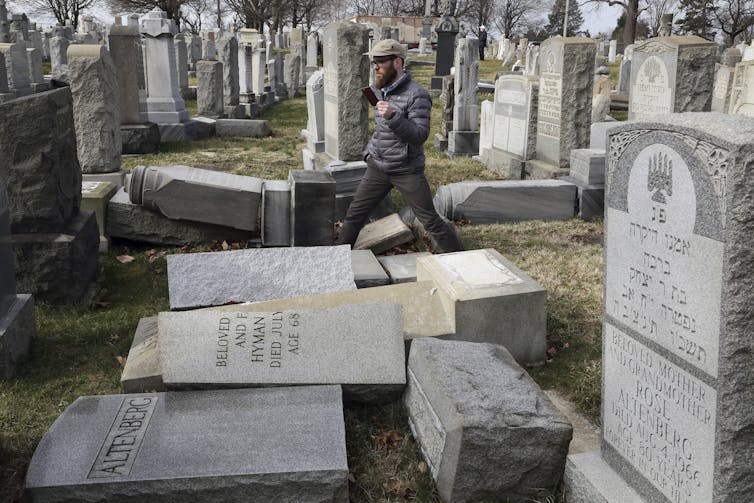
Keeping track of all the attacks confronting American Jews these days is just nigh impossible unless it's your full-time job. Consider these incidents, some of many that occurred or came to light just during the calendar month of Baronial 2019:
- A New York City rabbi was attacked with a paving stone.
- Footage surfaced of California high-schoolers singing Nazi songs and giving Nazi salutes a year earlier.
- An Ohio human was arrested for allegedly making threats to the Youngstown, Ohio, Jewish Community Middle.
- The Rockland Canton, New York, Republicans released an anti-Semitic assail advert against a Jewish legislator.
We are professors who teach public administration, a field that prepares students for government and nonprofit jobs. We have all worked in the public and nonprofit sectors, and we besides are all Jewish.
We never hid our religious identity before, simply nosotros also did not highlight it in our classrooms – until at present.
All of us believe we have a responsibility to train our students to work with diverse staff and serve diverse communities. After the mass shooting at Pittsburgh's Tree of Life synagogue on Oct. 27, 2018 - the deadliest attack on Jews in U.South. history - and other alarming acts, we sought resources to help usa address this tragedy. More broadly, we wanted to ameliorate equip our students to address anti-Semitism.
Since we could not find the specific books or scholarly articles in our field that nosotros needed to teach our students to sympathize anti-Semitism, we wrote our own article that appeared in the Journal of Public Diplomacy Pedagogy, an academic publication.
What it is
Anti-Semitism, the prejudice against or hatred of Jews, tin take the form of physical attacks, the expression of negative stereotypes or the promotion of hostility against Jewish people.
The most violent anti-Semitic acts, which the federal government considers a growing domestic terrorist threat, tend to attract the most attention.
But anti-Semitic acts can too manifest as microaggressions, which the pedagogy and psychology scholar Derald Wing Sue defines every bit "everyday verbal, nonverbal, and environmental slights, snubs, or insults, whether intentional or unintentional, which communicate hostile, derogatory, or negative messages to target persons based solely upon their marginalized group membership."
These microaggressions are farther compounded for Jews with intersectional identities – that is, those who are besides people of color, LGBTQ, immigrants or members of other minority communities.
Although less than 2% of U.S. adults are Jewish, at that place continues to be prove that anti-Semitism is on the rise. Well-nigh 90% of American Jews surveyed identified anti-Semitism as a problem, and 84% agreed that it has increased over the past v years - a perspective backed by information nerveless by Anti-Defamation League, an international nonprofit that tracks and fights anti-Semitism and all forms of bigotry.
"This hatred is existent, comes from multiple sources, and is growing," David Harris, who leads the American Jewish Commission, an advocacy organization, said. "Information technology needs to be taken seriously and dealt with in a sustained, multipronged response."
The toll it takes
Equally professors of public administration, we are particularly interested in the toll that anti-Semitism can have on the work government agencies and nonprofits do.
For case, Jewish organizations big and small are spending a growing corporeality of their time and money on security. Synagogues and customs centers are hiring armed guards and preparation volunteers and members of their congregations and organizations to become more than vigilant.
Anti-Semitism can besides interfere with the provision of government and nonprofit services.
In September, the sociology department at Wake Forest University in Winston-Salem, North Carolina, canceled classes for a week afterwards a dozen members of the kinesthesia received offensive, bearding emails with anti-Semitic sentiments.
Microaggressions can be disruptive, as well. For case, Jews are forced to either forgo the observance of important Jewish holidays, such as Rosh Hashanah, the Jewish New year, and Yom Kippur, the Day of Amende, or skip key events when they are only offered on those days.
Nosotros believe that these scheduling conflicts, even when they are unintentional, convey the implicit bulletin to Jews we are not truly role of our workplaces and communities.
Even when there are no schedule conflicts, many Jewish employees have to utilise vacation days or unpaid time off to detect holidays, especially when they autumn on weekdays. Jewish students in most U.Southward. counties take a chance having their absences being treated equally unexcused when they go to services instead of school or travel to observe religious holidays with their extended families.
A recent Twitter thread initiated past Rabbi Sara Zober highlights the struggles faced not just by American Jews only also past members of other religious minorities in systems that are prepare upwardly to back up Christian religious observance. To boot things off, she tweeted: "My middle schooler was marked "unexcused - domestic" for Rosh Hashanah, despite me letting them know two weeks early. That's the aforementioned designation equally if I kept him home from school waiting for a FedEx package."
We do, however, come across some steps in the right direction. A new Washington State police, for example, requires colleges and universities to "reasonably accommodate" any pupil when observing a religious holiday coincides with their academic obligations.
Merely some of the irenic anti-Semitic acts we find the most troubling are perpetrated past government leaders. Recently, two Trenton, New Jersey city quango members used variations of the offensive slur "Jew them down."
Demeaning language similar that signals to Jewish constituents that they are non equal members of the customs.

What you can do
As we work to train government and nonprofit leaders to address issues similar anti-Semitism, we besides have identified four simple steps that anyone can take to counter information technology.
Starting time, earlier you lot schedule events, y'all can check your calendars for the Jewish holidays. This is especially relevant in September and October, and in the springtime. These practices should besides encompass holidays other religious minorities celebrate, such as Ramadan for Muslims and Diwali for Hindus.
Second, practice not presume that the Jewish person, or anyone else belonging to a minority group, in your workplace will speak up to stave off a schedule conflict related to their holidays. Being a good ally means non placing the burden on them to constantly raise the issue.
Third, when an anti-Semitic incident makes headlines, attain out to your Jewish co-workers, and other people in your circles. Let them know you lot meet them, acknowledge their pain and are thinking of them.
Finally, endeavour to appoint in efforts to combat anti-Semitism in your community. This could mean getting involved with your local affiliate of the Anti-Defamation League or similar groups. Information technology can also entail participating in interfaith alliances, such as the Muslim-Jewish Informational Quango .
The feedback we have gotten in response to our bookish article suggests that it'due south already helping public and nonprofit leaders learn to talk about anti-Semitism in detail, and inclusion and social equity issues in full general. However, we believe that everyone has a responsibility to do something most this problem.
[ Like what you lot've read? Want more? Sign up for The Conversation's daily newsletter. ]
Source: https://theconversation.com/with-anti-semitism-on-the-rise-again-there-are-steps-everyone-can-take-to-counter-it-122116

Enregistrer un commentaire for "Ajnti Semstism on the Rise Everywhere Once Again?"